
BISP Automatically Eligible Filers Beneficiaries – Latest Update
The Benazir Income Support Programme (BISP) has once again become a major topic of discussion across Pakistan after introducing an important system correction related to women who are tax filers. For several months, many deserving women faced serious hardship when their Rs. 13,500 BISP payment was suddenly stopped without clear explanation. The main reason behind this issue was filer status — either of the woman herself or her husband. Due to system assumptions, being listed as a filer automatically increased the household’s poverty score, resulting in disqualification, even when the family was clearly struggling.
You can read more: Smart Wallet BISP Payment 2026
After reviewing public complaints, field reports, and real-life conditions, BISP has now revised its eligibility rules. Women who are filers but still live below the poverty line are being declared eligible again. This article explains the update in simple language so every affected woman can understand what changed and how to receive her payment without confusion.
Why Rs. 13,500 Payments Were Stopped for Women Filers
When BISP strengthened data sharing with FBR records, tax filer status became a key factor in determining eligibility. The system assumed that anyone who files tax returns has stable income — an assumption that does not reflect Pakistan’s economic reality.
Many women became filers due to technical or unavoidable reasons, such as:
-
SIM card registration
-
Small bank accounts
-
Compliance requirements
-
Avoiding legal or service-related issues
Despite having little or no income, their filer status raised their PMT (Poverty Means Test) score, making them appear financially strong in the system. As a result, thousands of deserving women were automatically removed from the programme.
Main reasons for suspension included:
-
Woman registered as a tax filer
-
Husband listed as a filer in FBR records
-
Multiple filers in one household
-
Automatic increase in PMT poverty score
How Filer Status Increased the Poverty Score
A key factor in determining eligibility for BISP is the PMT poverty score. Even a small increase can push a family above the qualifying threshold. When filter data was added, the system raised scores without checking actual living conditions.
In Pakistan, filing tax returns does not always mean high income. Unfortunately, the system failed to distinguish between low-income filers and financially strong individuals, leading to unfair exclusions.
Key points about the poverty score:
-
PMT is based on household data
-
Filer status added negative weight automatically
-
Real income was not always verified
-
Ground realities were initially overlooked
BISP System Correction and Policy Update
After months of internal review and complaints, BISP introduced a major system update. The new approach focuses on real household conditions instead of treating filer status as proof of financial stability.
Under the revised policy, low-income filer households are being re-evaluated, and many women are being restored into the programme.
Key improvements in the new system:
-
Automatic disqualification for filers removed
-
Low-income filer households rechecked
-
Updated socio-economic data used
-
Fair inclusion of deserving women
Which Women Are Eligible Again?
Many women who were previously marked ineligible are now being declared eligible under the revised rules, especially those whose filer status did not reflect financial strength.
This update is particularly helpful for:
-
Widows
-
Divorced women
-
Elderly women
-
Women-led households
Women included in restored eligibility:
-
Low-income women filers
-
Families wrongly tagged as filers
-
Widows with a file history
-
Households below the poverty threshold
Importance of NSER Data in Eligibility Restoration
To improve accuracy, BISP is updating records through NSER (National Socio-Economic Registry) surveys. This process helps correct outdated or incorrect information and ensures decisions are based on current living conditions.
NSER data collection plays a vital role in preventing deserving families from being excluded due to old system records.
Why NSER data matters:
-
Reflects real household conditions
-
Corrects past errors
-
Supports fair and transparent decisions
How to Check Your Updated Eligibility Status
Women who were previously disqualified should immediately check their status on the official BISP portal. Many beneficiaries have already seen their status change to “Eligible” after the update.
Eligibility updates are being applied in phases, so regular checking is recommended.
Steps to check eligibility:
-
Visit the official BISP portal
-
Enter your CNIC number
-
Read the eligibility message carefully
-
Follow any instructions shown
SIM Verification – Why It Is Necessary
Some women may see a message asking them to verify or obtain a SIM card. This does not mean rejection. It simply means the system requires SIM verification to activate digital payments.
The SIM must be registered on the beneficiary’s CNIC to proceed.
SIM verification is required because:
-
Payments are linked to digital wallets
-
Identity verification is mandatory
-
Fraud and duplication are prevented
When Will Rs. 13,500 Be Released?
According to official sources, women whose eligibility has been restored and who complete SIM verification will receive their Rs. 13,500 payment in March.
Once verification is completed, payments will be transferred directly through the digital system without unnecessary delays.
| Process Stage | Current Status |
|---|---|
| Eligibility review | Ongoing |
| NSER data update | In progress |
| SIM verification | Required for some |
| Payment release | March |
How to Withdraw Rs. 13,500 Safely
After payment release, beneficiaries can withdraw funds from authorised BISP payment centres or biometric points.
To avoid problems, women should carry original documents and ensure biometric verification is successful.
Requirements for withdrawal:
-
Original CNIC
-
SIM registered on CNIC
-
Successful biometric verification
You can read more: BISP 8171 CNIC Verification for December 2025 Payment – Latest Complete Guide
Important Advice for Previously Disqualified Women
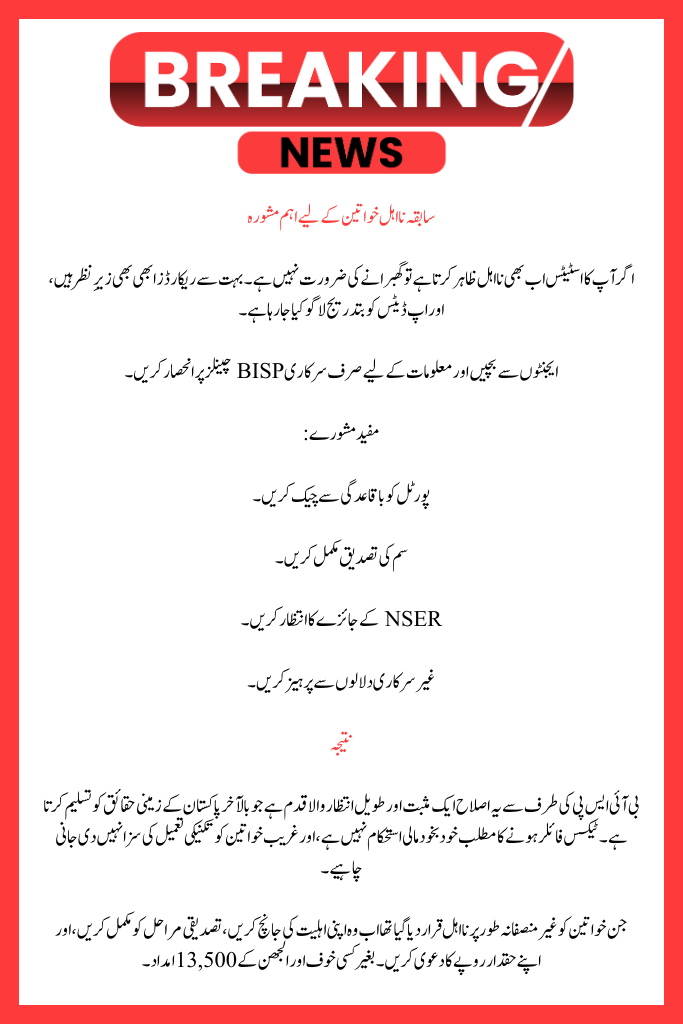
If your status still shows ineligible, there is no need to panic. Many records are still under review, and updates are being applied gradually.
Avoid agents and rely only on official BISP channels for information.
Helpful tips:
-
Check the portal regularly
-
Complete SIM verification
-
Wait for NSER review
-
Avoid unofficial middlemen
Conclusion
This correction by BISP is a positive and long-awaited step that finally acknowledges Pakistan’s ground realities. Being a tax filer does not automatically mean financial stability, and poor women should not be punished for technical compliance.
Women who were unfairly disqualified should now check their eligibility, complete verification steps, and claim their rightful Rs. 13,500 assistance without fear or confusion.
FAQs
1. Am I now qualified for BISP Rs. 13,500 if I submit taxes?
Indeed. A woman is no longer automatically disqualified for filing taxes under the most recent BISP system upgrade. Your eligibility is being reevaluated if you filed but your family income is still below the poverty line. After evaluation, a large number of low-income filer women have already been reinstated into the programme.
2. “Ineligible” was the prior BISP status I had. Do I need to reapply?
No new application needs to be submitted. BISP uses updated NSER data to automatically examine records. You should use your CNIC to frequently verify your eligibility status on the official BISP portal. After completing any necessary verification, your payment will be issued if your status changes to “Eligible”.
3. Why is SIM verification required in order to get paid Rs. 13,500?
To connect your identification to the digital payment system, SIM verification is necessary. To avoid fraud, duplication, and financial mismanagement, the SIM must be registered on your CNIC. Your payment procedure becomes operational, and you may immediately withdraw your money when SIM verification is finished.