
Punjab Launches BISP-Free SIM Cards
During a visit to the BISP office in Karachi, Federal Minister for Poverty Alleviation and Social Protection Syed Imran Ahmed Shah assessed the implementation of the new digital Qist mechanism. He was briefed on the distribution of free SIM cards to eligible women, ensuring secure and direct transfers of future Kafalat payments. This visit addressed confusion among beneficiaries regarding Qist delays and system changes, emphasising the importance of providing clarity on timelines and procedures. Shah outlined the government’s strategic shift from cash-based disbursements to a more efficient digital model, aiming for improved management and monitoring of assistance programmes.
You can read more: The IMF suggests increasing BISP assistance by Rs 14,500 in 2026
Dignified Kafalat Qist: The Government’s Vision
According to the minister, the reforms being implemented are under the direct instructions of Prime Minister Shehbaz Sharif, aiming to ensure that women receive their Kafalat Qist with dignity, free from the burdens of long queues and reliance on agents. The government believes leveraging technology can mitigate exploitation and foster trust between beneficiaries and institutions. This initiative transcends mere convenience; it emphasises respect, privacy, and transparency. With the Qist directly deposited into digital wallets linked to SIM cards, women will gain greater control over their assistance, reducing instances of deductions or fraud, which have plagued previous systems.
BISP SIM-Based Digital Wallet System Launch
• BISP is issuing free SIM cards that serve as digital wallets for payment transfers.
• Millions of digital wallet accounts have been opened, indicating a widespread transition.
• The system is designed to suit Pakistan’s context, facilitating access for women without bank accounts who own mobile phones.
• SIM-based wallets help improve financial inclusion, particularly in rural and low-income urban regions.
Pakistan Province’s BISP SIM Distribution Progress
• Rapid progress in SIM card distribution in the Pakistani province.
• Digital wallet SIM cards are being issued at 138 locations.
• A total of 593,958 SIM cards have been distributed.
• Provincial centres assist women by guiding them, verifying data, and handing out SIM cards.
• The localised approach eases pressure on central offices and improves accessibility for women in remote districts.
BISP 13500 Qist’s current state for beneficiaries
• Many women have received payments under the earlier system, while others are still waiting.
• Delays in the pending cases are due to SIM card distribution and data updates, not disqualification.
• It’s important to clarify that many women mistakenly believe they have been removed from the programme.
• Women receiving Qist messages from BISP but not money should not panic; their cases are likely in the transition phase.
• The Qist system will be aligned once the SIM-based system is fully operational.
BISP March 2026 Schedule for Remaining Payments
• Women with SIM cards will begin receiving pending payments from March 2026.
• No Qist will be issued before this date via digital wallet SIMs to avoid repeated visits to Qist centres.
• The waiting period aims to facilitate system testing and stabilisation.
• Once operational, the system is expected to enhance the future Qist process, making it smoother and more predictable.
• Key Update: Official Details
• SIM Distribution: Ongoing across Sindh
• Total Centers: 138 locations
• SIMs Distributed: 593,958 so far
• Qist Start Date: March 2026
• SIM Distribution Pause: After Dec 20, 2025
| Item | Details |
|---|---|
| Free SIM Purpose | Digital wallet for BISP Kafalat payments |
| SIM Distribution Status | Ongoing (pausing after 20 Dec 2025) |
| Total Distribution Centres | 138 locations |
| SIMs Issued So Far | 593,958 |
| Pending Qist Release | From March 2026 |
| Key Instruction | Do not use or activate SIM yourself |
Important Guidelines for Women Receiving SIM Cards
• Women who received SIM cards must adhere to official instructions to avoid complications.
• Personal use of the SIM may lead to technical issues and delays in Qist.
• Do not activate or register the SIM independently.
• Avoid creating any account or PIN associated with the SIM.
• Refrain from using the SIM for calls, SMS, or internet services.
• Keep the SIM secure and unused until it is officially activated.
• Compliance with these guidelines is crucial for uninterrupted advance crediting.
What Women Should Do If They Have Unanswered Messages
• Some women received messages from BISP regarding Qist or eligibility but did not get further communication.
• These women are advised to stay alert and verify that their data is updated.
• After verification, they may receive a new message for SIM card collection.
• Provincial centres are directed to assist cases with incomplete or recently updated records.
Provincial SIM Distribution Centres’ Function
• Provincial SIM distribution centres have been set up in Pakistan to ease travel for women.
• Beneficiaries can now collect SIM cards closer to their homes instead of having to travel to major cities.
• This initiative is especially beneficial for elderly women and those living in remote areas.
• The centres offer basic guidance, aiding women in understanding timelines, precautions, and next steps in simple language.
Poverty Score’s Effect on Future Qist
• Eligibility for future Kafalat Qist is based on the poverty score.
• Women with a poverty score within the approved threshold will receive assistance in future cycles.
• This approach targets support to the most deserving families.
• Accurate household data is crucial for future assessments that will depend on these records.
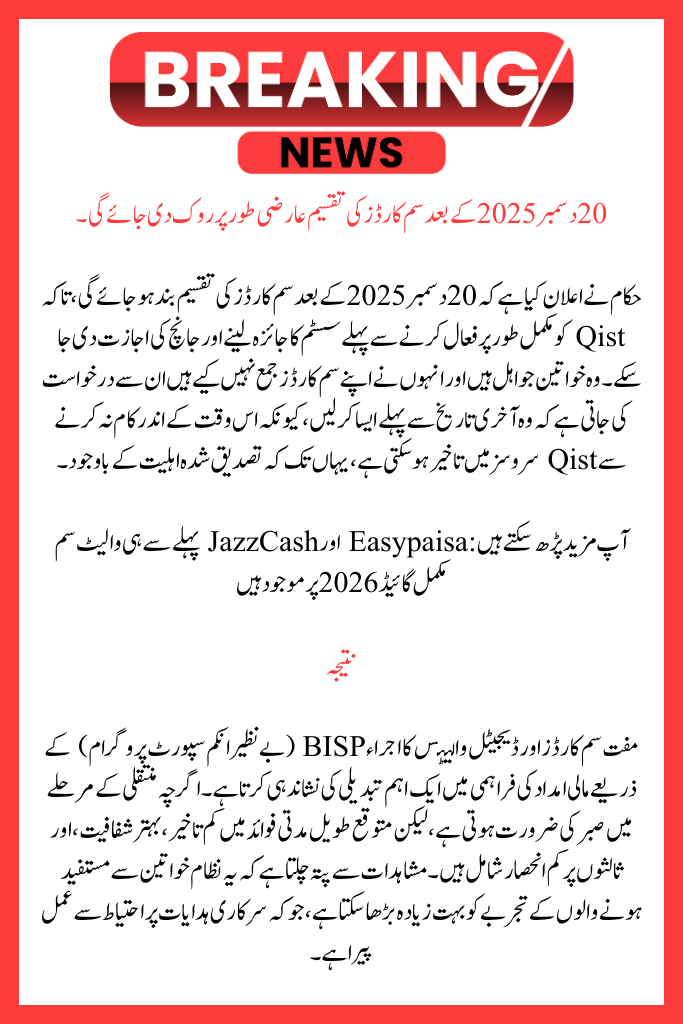
Distribution of SIM cards will temporarily stop after December 20, 2025.
Authorities have announced that the distribution of SIM cards will cease after December 20, 2025, to permit a review and testing of the system prior to the full-scale activation of Qist. Women who are eligible and have not collected their SIM cards are urged to do so before the deadline, as failing to act within this timeframe may lead to delays in Qist services, even with confirmed eligibility.
You can read more: Easypaisa and JazzCash are already present on Wallet SIM Full Guide 2026
Conclusion
The rollout of free SIM cards and digital wallets marks a significant transformation in the delivery of financial assistance by BISP (Benazir Income Support Programme). Although the transition phase necessitates patience, the anticipated long-term benefits include reduced delays, enhanced transparency, and lower dependency on intermediaries. Observations indicate that this system could greatly enhance the experience for women beneficiaries, contingent upon careful adherence to official instructions.
FAQs
1. Despite my continued eligibility, why has my BISP Qist been delayed?
The transition from cash payments to SIM-based digital wallets is the main cause of delays. Instead of being cancelled, your case is probably undergoing a system transformation. After the digital system is operational, payments will continue.
2. Can I make calls or use the internet with the free BISP SIM?
No. The SIM card is only used for BISP transactions. Your Qist may be delayed if you use it for personal use or activate it yourself.
3. If I get a BISP notice but there’s no update, what should I do?
You should visit a provincial BISP facility to make sure your personal information is accurate and comprehensive. You can see a new notice about SIM collection or payment status once it has been validated.