
Cards Blocked by BISP
BISP Blocked Cards: The Benazir Income Support Program has provided crucial support to millions of families in Pakistan. Recently, numerous beneficiaries encountered issues with their BISP cards being blocked due to problems such as PTCL bill payments, outstanding loans, or high-income records, causing significant concern, particularly among women who depend on this aid for essential household needs.
You can read more: Rubina Khalid Visits the Karachi BISP Centre to Discuss Future Digital Wallet Payments and Free SIMs
The Government of Pakistan has started an automatic restoration process for all blocked BISP cards, conducted in phases and free of charge. This article offers a comprehensive guide for beneficiaries, detailing the reasons for card blockages, the restoration process, and essential safety precautions.
Reasons for Blocking BISP Cards
Many beneficiaries experienced confusion due to unexpected card blockages, which were a result of automated verification checks aimed at ensuring that only eligible households receive support. Specific issues included discrepancies in PTCL bill payments, outstanding loans linked to CNICs, and high-income indicators in government databases. These precautionary measures were implemented to verify eligibility and direct support to the most deserving families.
The official announcement on automatic card restoration
The government assures beneficiaries to remain calm as blocked cards are being automatically reopened via the BISP system without manual intervention. Restoration occurs in phases, with some cards being restored sooner than others, dependent on data verification. Patience is essential during this time.
| Topic | Details |
|---|---|
| Reason for Card Block | PTCL bill discrepancies, outstanding loans, high-income indicators, eligibility verification. |
| Restoration Process | Automatic, system-driven, phased, and free of charge; no manual application required. |
| Fraud Precautions | No agents or fees; do not share CNIC with strangers; trust only official BISP sources. |
| Status Verification | Send CNIC to 8171 or check https://8171.bisp.gov.pk/. SMS notifications confirm restoration. |
| Payment Collection | Cash centres or mobile wallets once the card is restored. |
| Advice for Women | Keep your CNIC and mobile number updated; avoid handing your card to others; and report suspicious activity. |
| Prevent Future Blockages | Monitor PTCL bills and household financial records; respond to official messages immediately. |
• Restoration is fully automatic and system-driven.
• No manual request or application is required.
• Cards are being reopened in phases.
• The process ensures that all eligible beneficiaries will regain access without extra effort.
No Bribes, Agents, or Fees
• Individuals are attempting to exploit card blockages by offering paid unblocking services, which are fraudulent.
• The government has stated that the unblocking process is free of charge.
• Beneficiaries should not pay anyone for card restoration.
• Personal details, including CNIC, should not be shared with strangers.
• Trust only official announcements and messages from BISP to avoid fraud and financial loss.
PTCL Bills, Loans, and Income Data’s Function
• BISP verification involves multiple databases such as PTCL bills, loan records, and income indicators.
• Temporary blockages arise upon detection of inconsistencies.
• Restoration of status occurs automatically once discrepancies are resolved.
• PTCL billing data is cross-checked with CNIC.
• Loan records are reviewed to evaluate financial standing.
• Income indicators are reassessed for eligibility.
• This system enhances the programme’s long-term accuracy and fairness.
How Recipients Can Verify Their Status
• Beneficiaries should utilise official channels for information, despite automatic restoration.
• Regularly checking status can alleviate anxiety and prevent misinformation.
• To verify card status, send CNIC to 8171.
• Real-time updates are available on the official BISP portal: https://8171.bisp.gov.pk/.
• SMS notifications will confirm restoration.
• Using official sources guarantees accurate and secure information.
After Card Restoration, Payment Collection
• Once a card is restored, beneficiaries can resume receiving payments through authorised channels.
– The payment process is consistent, ensuring continuity and convenience.
– Payment methods include:
– Cash Centres: Visit an authorised centre with CNIC.
– Mobile Wallet: Funds are transferred directly to the wallet.
– Utilising official channels guarantees safety and timely access to funds.
Particular Advice for Female Recipients
• Women play a crucial role in BISP, and efforts are made to safeguard their rights.
• During card blockages, many women experienced targeted fraud attempts.
• Awareness and vigilance are critical to prevent fraud.
You can read more: BISP Rs 13,500 Assistance Check using CNIC’s 8171 Web Portal 2026
• Key precautions include:
– Keeping CNIC and registered mobile numbers updated.
– Avoiding the handover of cards to unauthorised individuals.
– Reporting suspicious activities immediately.
• Following these precautions helps maintain dignity and security and ensures continuous financial support.
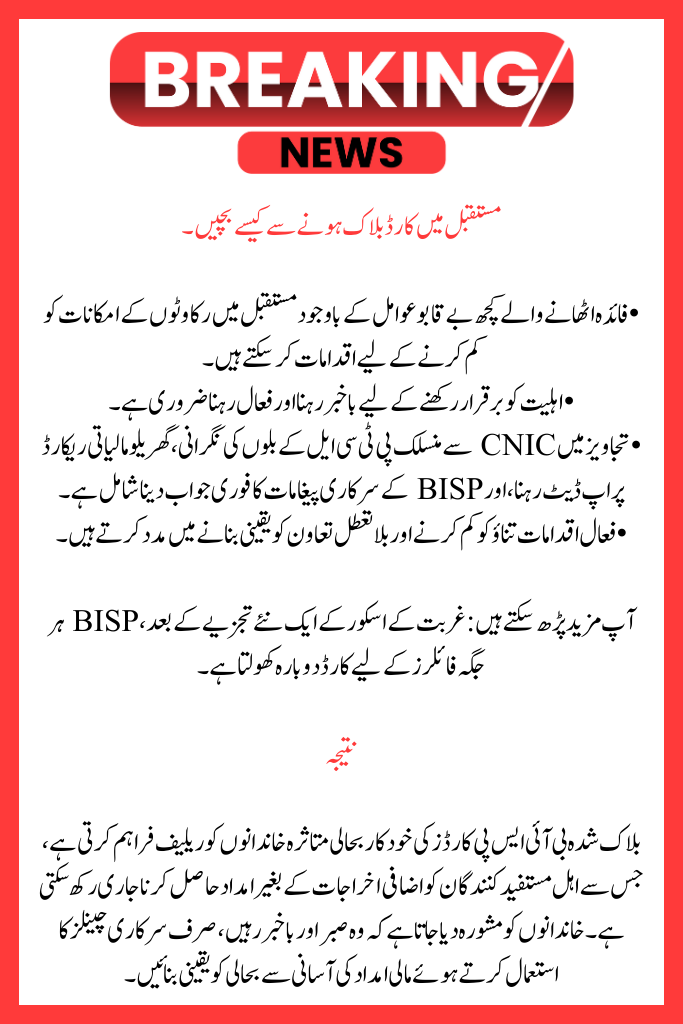
How to Avoid Card Blockages in the Future
• Beneficiaries can take steps to reduce the likelihood of future blockages despite some uncontrollable factors.
• Staying informed and proactive is essential to maintain eligibility.
• Suggestions include monitoring PTCL bills linked to CNIC, staying updated on household financial records, and responding promptly to official BISP messages.
• Proactive measures help reduce stress and ensure uninterrupted support.
You can read more: After a new analysis of poverty scores, BISP reopens cards for filers everywhere.
Conclusion
The automatic restoration of blocked BISP cards provides relief to affected families, allowing eligible beneficiaries to continue receiving support without added costs. Families are advised to remain patient and informed, using only official channels to ensure the smooth resumption of financial assistance.
FAQs
1. What caused my BISP card to be blocked?
Cards may be restricted because of high-income indications in government databases, outstanding debts, or disparities in PTCL bills. These verifications guarantee that qualified households receive assistance.
2. How can I get my blocked BISP card back?
Restoration is free, automated, and system-driven. There is no need for a manual request. Recipients can use the official portal or text CNIC to 8171 via SMS to check their status.
3. What steps can I take to prevent fraud?
Never give out personal CNIC information or pay agents. Only pay attention to official BISP messages and announcements. Any questionable activities should be reported right away.