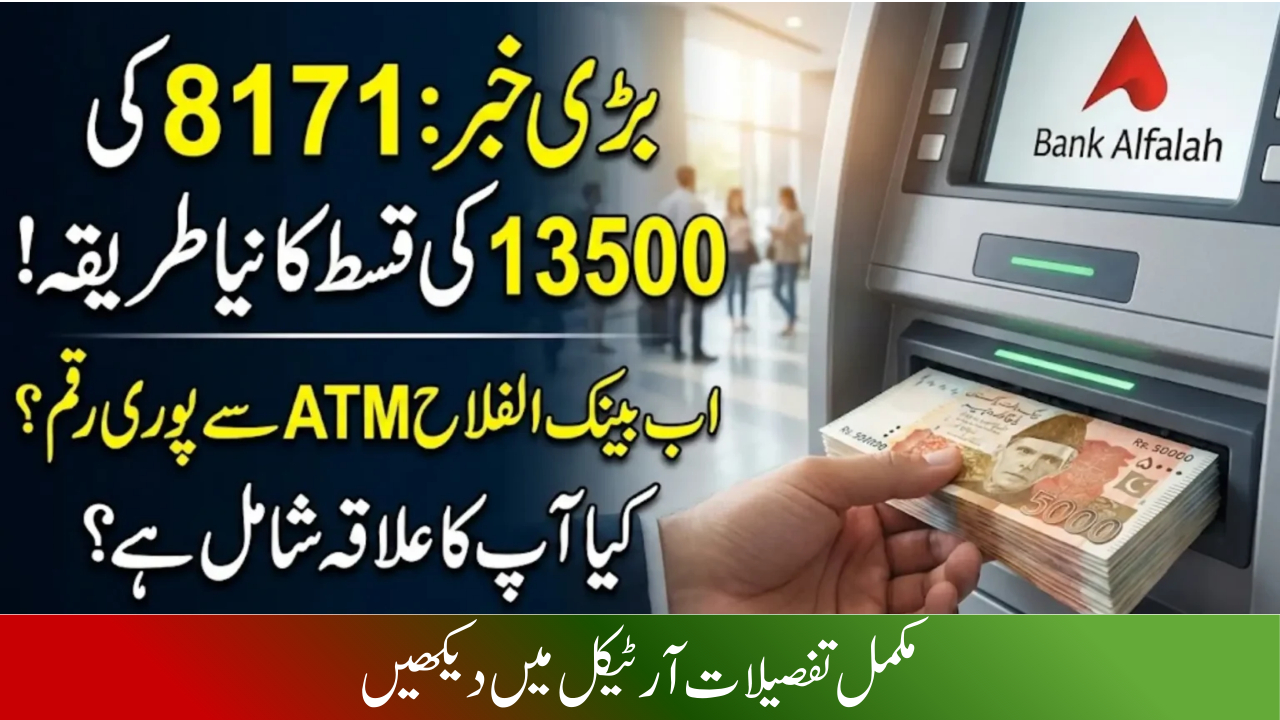
Payment via Bank Alfalah ATM for BISP 8171: Rs. 13500
The Government of Pakistan has officially begun disbursing the BISP 8171 Rs. 13,500 instalment through selected Bank Alfalah ATMs, marking a major improvement in the welfare payment system. This new facility enables eligible beneficiaries to withdraw their financial assistance directly from ATMs, reducing dependence on retailers and minimising issues such as long waiting times and unauthorised deductions.
This 2026 update brings significant relief to millions of families enrolled in the Benazir Income Support Programme (BISP). By introducing ATM-based withdrawals, the government aims to make welfare payments safer, more transparent, and more respectful—particularly for women, senior citizens, and daily wage earners.
You can read more: Update the Ehsaas 8171 Payment Tracking Portal to Verify Your Eligibility and Payment Status
Key Highlights of the Update
-
Rs. 13,500 payments are now available via selected Bank Alfalah ATMs
-
ATM withdrawals introduced alongside the existing retailer system
-
Greater transparency, safety, and dignity for beneficiaries
What Has Changed in the BISP 8171 Payment System in 2026?
Under the revised BISP 8171 payment mechanism, eligible families now have the option to withdraw their funds through ATMs rather than relying entirely on payment retailers. This change allows beneficiaries to access their money independently, reducing delays and giving them more control over their assistance.
The retailer system has not been discontinued. Instead, both systems operate together to ensure uninterrupted payments, especially in areas where ATM access is limited.
Key Changes
-
ATM withdrawal option launched in selected locations
-
Retailer payments continue nationwide
-
Increased independence for beneficiaries
Overview of Rs. 13,500 BISP Payments via Bank Alfalah ATMs
The rollout of BISP Rs. 13,500 payments through Bank Alfalah ATMs is being carried out in phases. This gradual approach allows authorities to monitor biometric verification, resolve technical issues, and ensure smooth operation before expanding the service to additional areas.
For many beneficiaries, this is their first experience using an ATM to receive government financial assistance. The initiative reflects the government’s broader goal of modernising welfare delivery while keeping low-income families at the centre of policy decisions.
Implementation Highlights
-
Phased rollout for better system stability
-
First-time ATM access for many beneficiaries
-
Nationwide expansion planned
Why the Rs. 13,500 BISP Payment Is Important in 2026
With rising inflation and increasing household expenses, financial assistance has become more crucial than ever. The Rs. 13,500 BISP payment helps families manage essential costs such as food, healthcare, education, and utility bills.
Receiving the full amount without deductions provides immediate financial relief and reduces the need for borrowing, offering short-term stability during difficult economic conditions.
Benefits
-
Helps cope with rising living costs
-
Supports basic household needs
-
Reduces reliance on loans
Areas Where Bank Alfalah ATM Payments Are Currently Active
At present, BISP payments through Bank Alfalah ATMs are available only in selected cities and districts. Not all Bank Alfalah ATMs are enabled for BISP transactions, so beneficiaries are advised to confirm availability locally before visiting an ATM.
The phased rollout allows authorities to address issues early and improve reliability before expanding coverage.
Current Status
-
ATM withdrawals limited to notified locations
-
Not all Bank Alfalah ATMs are enabled yet
-
Expansion planned in stages
Eligibility Criteria for ATM Withdrawal of Rs. 13,500
Only beneficiaries with an active BISP or Benazir Kafalat status are eligible to withdraw payments from Bank Alfalah ATMs. Biometric verification is mandatory, and the CNIC must match official records.
If biometric verification fails or eligibility is not confirmed, beneficiaries can still collect their payments through authorised retailers.
Eligibility Requirements
-
Active BISP or Kafalat enrollment
-
Valid CNIC
-
Successful biometric verification
How to Withdraw BISP Payment From a Bank Alfalah ATM
The ATM withdrawal process has been designed to be simple and user-friendly, even for individuals with limited education or ATM experience. Clear on-screen instructions guide beneficiaries through each step, and assistance may be available at some locations.
Step-by-Step Withdrawal Guide
| Step | Action |
|---|---|
| 1 | Visit a BISP-enabled Bank Alfalah ATM |
| 2 | Select the BISP or government payment option |
| 3 | Enter your 13-digit CNIC number |
| 4 | Complete thumb biometric verification |
| 5 | Collect cash and receipt |
If the ATM is inactive or biometric verification fails, beneficiaries can try another enabled ATM or collect payment through a retailer.
Role of Retailers After the Introduction of ATM Payments
Retailers remain an essential part of the BISP payment system, particularly in rural and remote areas. The introduction of ATM withdrawals does not replace retailers but provides an additional option for beneficiaries.
This dual system ensures flexibility and uninterrupted access to payments based on location and convenience.
Retailer System Status
-
Retailers remain active nationwide
-
Critical for rural and remote regions
-
Alternative option if ATM or biometric issues occur
Common ATM Withdrawal Issues and Their Solutions
Some beneficiaries may face problems such as biometric mismatches or temporarily inactive ATMs. These issues are usually technical and can often be resolved by trying another ATM or choosing the retailer option.
Common Problems and Solutions
-
Biometric mismatch: Try a different ATM or visit a retailer
-
ATM not working: Visit another enabled location
-
Payment issue: Check status via the 8171 service
How to Check BISP 8171 Payment Status Safely
Beneficiaries should always use official channels to check their payment status and avoid fraud. Fake calls and messages often circulate during payment cycles, so caution is essential.
Official Verification Methods
-
Send CNIC via the 8171 SMS service
-
Check status on the official BISP portal
-
Visit authorized BISP offices
Never share CNIC or biometric information with unknown individuals.
Benefits of ATM-Based BISP Payments
ATM-based payments provide greater transparency and independence by allowing beneficiaries to withdraw their full amount themselves. This reduces the risk of deductions and overcrowding at retail shops.
Women beneficiaries especially benefit from increased privacy and control over their funds.
Key Advantages
-
Full payment without deductions
-
Less crowding and waiting time
-
Improved dignity and independence
Comparison of BISP Payment Methods
| Feature | Bank Alfalah ATM | Retailer |
|---|---|---|
| Withdrawal Type | Self-service | Assisted |
| Transparency | High | Medium |
| Risk of Deductions | Very low | Possible |
| Best For | Cities & semi-urban areas | Rural areas |
Both methods remain important, and beneficiaries can choose based on convenience and access.
Future Expansion of Bank Alfalah ATM Payments
Authorities have indicated that the performance of the current phase will determine future expansion. More areas—and possibly additional banks—may be included to broaden access to digital payments.
This initiative represents a significant step toward a more transparent, efficient, and inclusive welfare system in Pakistan.
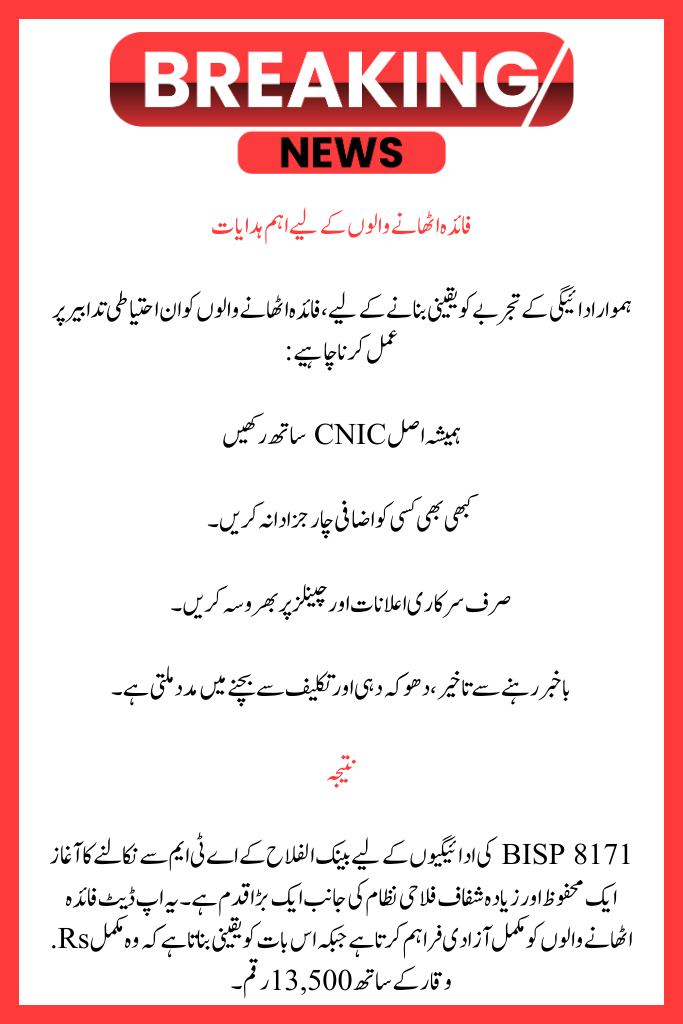
Important Instructions for Beneficiaries
To ensure a smooth payment experience, beneficiaries should follow these precautions:
-
Always carry the original CNIC
-
Never pay extra charges to anyone
-
Rely only on official announcements and channels
Staying informed helps avoid delays, fraud, and inconvenience.
You can read more: BISP 8171 SIM Usage Guidelines 2026: Safe Use of Your BISP SIM and Payment Security
Conclusion
FAQs
What is the latest information regarding the BISP 8171 Rs. 13,500 ATM payment?
In 2026, it permits qualified recipients to take out their Rs. 13,500 payment using specific Bank Alfalah ATMs.
Is it possible to use an ATM anywhere in Pakistan?
No, it is presently restricted to a few locations and will progressively grow.
Who can take money out of Bank Alfalah ATMs?
beneficiaries who have successfully completed biometric verification and have active BISP or Benazir Kafalat status.
Are merchants still accepting payments?
Retailers do indeed still exist, particularly in rural and isolated places.
How can one safely verify the status of a payment?
via the BISP portal, authorised BISP offices, or the official 8171 SMS service.